Why Is My Mould Screen Sagging, and How Do I Tighten It?
Quick answer
Check the staples first. If they are loose or rusty, lift them along the slack side, pull the screen taut, and staple again from the center of the edge outward. If the staples are sound and the screen still bellies out in the middle, it needs a backing of hardware cloth or ribs.
Is this your problem?
Symptom: Mould screen sags or wrinkles instead of staying tight
The screen on your mould has gone soft. It may droop in the middle when wet, ripple across the surface, or feel loose along one side.
Check it dry and wet. Some screens look fine until the pulp lands on them. Lay a straightedge across the frame, first with the screen dry and then with it wet. A gap under the straightedge means a sag.
The sheet may tell you first. One US patent on papermaking gear notes that a deformed mould makes it hard to control the thickness of a sheet, so look for sheets that are thick in one place and thin in another in the same position each time. The Papertrail adds that a supported screen allows more pressure when you couch the sheet off. If sheets stick to the screen when you couch, check the screen as well.
This guide covers Western-style moulds with a stapled screen. A bamboo su in a keta frame is a different system, and tightening it is a different job.
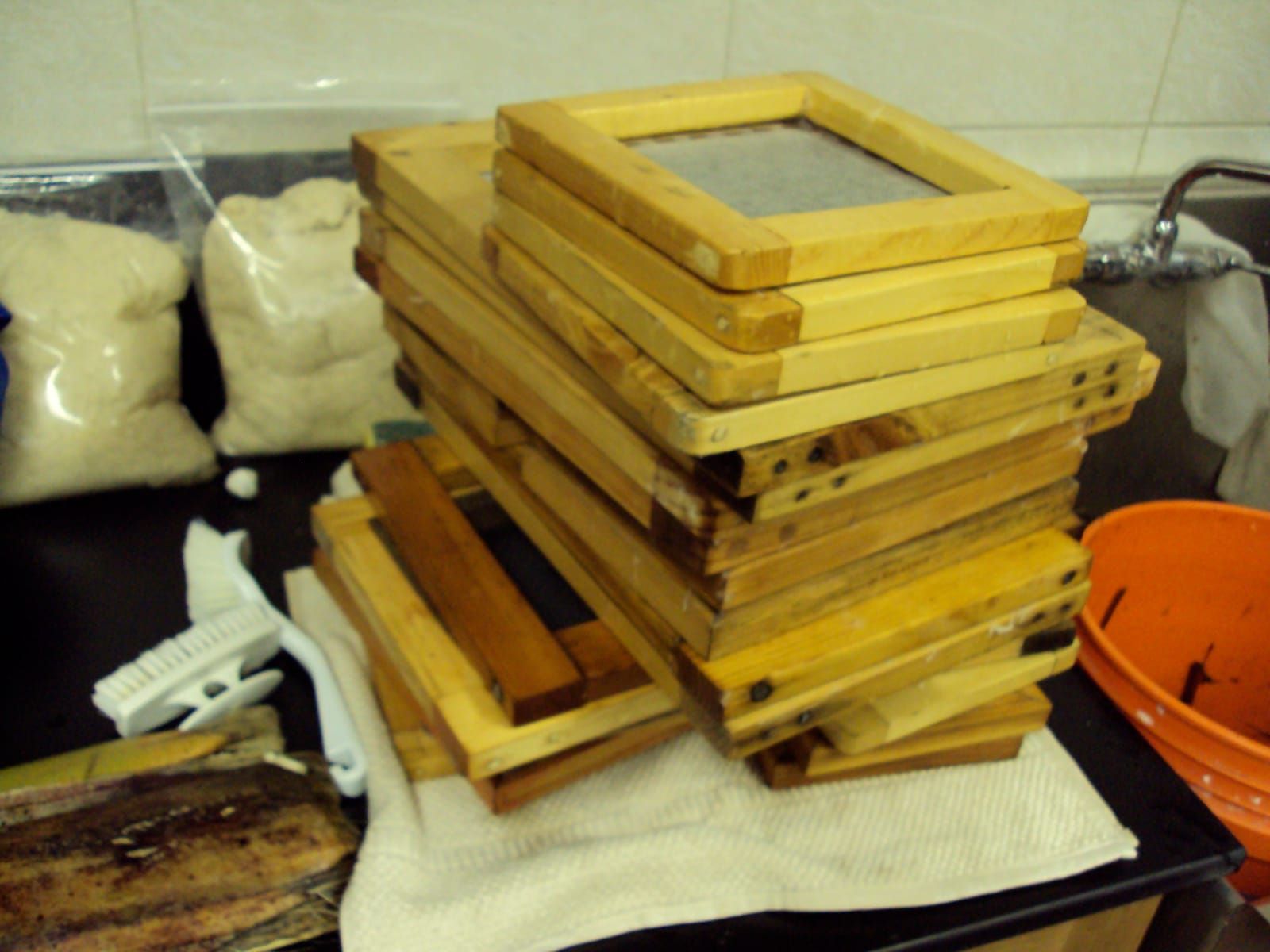

Similar symptoms
Ranked causes
| Cause | Tell-tale sign | Quick check | Fix |
|---|---|---|---|
| No support under a flexible screen | Pulp runs under the deckle, or a large mould has window screening alone | Lay a straightedge across the wet screen and look for a gap | Add a backing of hardware cloth, or ribs or egg crate under the screen |
| Staples loose, pulled out, or rusted | Slack along one side, or rust stains at the staples | Run a fingertip along each edge and test each staple | Replace the bad staples and re-tension that side |
| Screen was never stretched evenly | Wrinkles or diagonal ripples that have been there since the mould was built | Look across the empty screen at a low angle against the light | Re-stretch it, stapling from the center of each edge outward |
| Frame has warped or loosened at the corners | The mould rocks on a flat table, or the deckle no longer sits flat | Set the bare frame on a flat table and check each corner with a square | Reglue or pin the corners if the frame is still true, or rebuild the frame |
Diagnose in order
Change one thing at a time. Check each item before you pull a staple.
- Set the frame on a flat table. If it rocks, the frame has warped. Fixing the screen will not help until the frame is true.
- Check each corner with a square. Look for open joints.
- Inspect the staples. Look for rust, lifted heads, and staples that have pulled out of the wood.
- Check the tension side by side. Press along each edge. A slack side tells you where to work.
- Lay a straightedge across the screen when wet. If it is taut along the edges but still bellies out in the middle, the screen needs support, not more tension.
- Look for damage. Torn mesh or broken wires need a new screen, not a tighter one.
Fixes, step by step
Take the mould out of use and let it dry
Separate the deckle and rinse off all pulp. Helen Hiebert notes that pulp is easiest to remove while it is still wet, so clean the mould right away, then let it dry out before you work on it.
Pull the staples along the slack side
Lift the staples along the loose edge with a flat screwdriver or staple lifter. Leave the other three sides in place. If the whole screen is slack, begin at the center of a long side.
Stretch the screen and staple from the center out
Pull the screen taut with one hand and set a staple at the center of the edge. May Babcock's instructions start with a staple at the center of each edge, then work outward from side to side. Mary Tasillo suggests a staple about every inch around the perimeter. Stretch as you go, and keep the screen flat.
Replace any rusted staples
One US patent on papermaking gear notes that staples and nails can rust after repeated use, contributing to uneven sheets. Set new staples beside the old holes, in sound wood.
Cover the edges
Trim loose ends and sharp wire. Cover the edges with duct tape, keeping the tape no wider than the frame so that it does not change the size of the sheet. The same patent notes that duct tape can wear out and come loose, so check it each session.
Add support under the screen if it still flexes
Both Tasillo and Babcock put a layer of hardware cloth directly against the frame, under the window screening. For larger moulds, Tasillo suggests gluing plastic egg crate, cut to size, directly beneath the screening. The Papertrail's ribbed moulds use ribs about 2 inches (5 cm) apart, held against the underside of the screen by a second frame, so the screen stays tight to the deckle. That frame screws off, so the back of the screen can be cleaned thoroughly.
Test the mould wet
Pull a practice sheet and check the straightedge again. Lay the deckle on top and see that it sits flat all the way around. Pull three sheets and compare them under a light before you get back to real work.
Prevent it next batch
- Seal bare wood with two or three coats of polyurethane before you attach a screen, as Tasillo does.
- Clean the mould and deckle after use, let them dry out, and store them flat to prevent warping, as Hiebert advises.
- Do not spray a hose hard at the back of the screen. Helen Hiebert warns that water pressure can force fibre between mesh layers.
- Check the staples and tape before every session.
- Note repairs on your batch log, so you can see whether the same side keeps failing.
When it's not fixable
A frame that has twisted or cracked will keep failing, however well you staple it. One US patent on papermaking gear notes that wood exposed to repeated moisture tends to warp, twist, and crack. At that point, build or buy a new frame. Keep the screen if it is still in good shape.
A torn or heavily corroded screen should be replaced rather than tightened.
FAQ
How tight should a mould screen be?
As taut as you can get it while keeping it flat. Mary Tasillo stretches the screen taut as she staples, and May Babcock makes sure the layers are flat and taut before she starts. None of our sources gives a measured tension.
Can I tighten a screen without building a new mould?
Yes, if the frame is sound and the mesh is not torn. Remove the staples along the slack side, pull the screen taut, and staple it again. If the screen is taut but still flexes under wet pulp, add support underneath. Rebuild only when the frame itself has warped.
Can a sagging screen cause thin spots?
It can make sheets uneven. The Papertrail explains that ribs under the screen keep it tight to the deckle, so pulp does not run between the deckle and the screen. One US patent on papermaking gear notes that a deformed mould makes it hard to control the shape and thickness of a sheet. If the same area is wrong on every sheet, check the screen first.
Why did a picture-frame mould start to sag?
One US patent on papermaking gear notes that wood repeatedly exposed to moisture tends to warp, twist, and crack, and that staples can rust after repeated use. Babcock's picture-frame mould puts hardware cloth under the window screening, staples from the center of each edge outward, and seals the wood with polyurethane if the frame needs it.
Related problems
Next stage: Why Is My Handmade Paper Thicker on One Side (Thin Spots and Holes)?
Sources and further reading
- Constructing a Basic Mould and Deckle, by Mary Tasillo (Hand Papermaking Newsletter #84)
- Make a Mould and Deckle for Handmade Paper, cheat sheet by May Babcock
- Ribbed Polyethylene Moulds (Papertrail)
- US Patent 7507315, Paper making apparatus and method
- Paper Making 101, by Francois Vigneault (Make:)
- Setting Up a Studio, by Helen Hiebert (Hand Papermaking Newsletter #70)