Why Are There Drip Marks or Craters on My Wet Sheet?
Quick answer
Watch the next pull. Let the water drain to a drip, then lift the deckle straight up and carry it away from the sheet, not over it. Magnolia Editions' glossary of flaws describes crater-like marks made when drops fall from the papermaker or the deckle onto a newly formed sheet. If marks persist, look for foam.
Is this your problem?
Symptom: Wet sheet shows drip marks, craters, or bare rings
The sheet formed well, and then small pits or rings appeared. They may show up across the sheet or in a line where something passed overhead.
Magnolia Editions' glossary of flaws in handmade paper names this defect. Drops that fall from the vatman or the deckle onto a newly formed sheet leave vatman's drip marks. Drops that fall after couching, onto the exposed side of the sheet, leave coucher's drip marks. Both are crater-like. On a laid mould there is a clue: the glossary says the laid pattern stays visible inside a vatman's drip mark, but is disrupted or missing inside a coucher's drip mark.
Separate it from two look-alikes. A thin spot is an area where less fibre settled during forming. It has soft edges and is often in the same place every time. A cloudy patch is a clump, not a pit. Air trapped between the felt and a newly couched sheet is a third: the glossary describes raised bubbles that, once pressed, leave round thin areas with thickened margins.

Similar symptoms
Ranked causes
| Cause | Tell-tale sign | Quick check | Fix |
|---|---|---|---|
| Drops falling onto the sheet from the deckle or hands | Round pits or rings, scattered where the deckle passed or your hands reached across | Lift the deckle away from the sheet on the next pull and keep your hands clear | Move the deckle away before you shake it off, and dry your hands |
| Water falling from the mould after couching | Marks that appear on the couched sheet as the mould lifts away | Swing the mould aside to clear the post on the next couch | Move the mould to the side as soon as it is clear of the felt |
| Sheet tilted or handled before it drained | The fibre mat has slid, wrinkled, or broken toward one side | Hold the mould level until the water drains to a drip | Level the mould at once, then keep it still until it drains |
| Air bubbles or foam on the vat | Round, ringed, or crater-like marks with no drips nearby, and foam that lingers on the vat | Look at the vat surface before you pull the next sheet | Find what keeps the foam alive, such as gelatin or other protein in the vat |
Diagnose in order
Change one thing per pull. The next sheet is the test, so watch it closely.
- Check the wet sheet right after draining. If it is clean at this stage and marks appear later, something dripped on it.
- Watch the deckle. Lift it off and see where it drips.
- Watch your hands. Are wet fingers or sleeves reaching over the sheet?
- Watch the couch. Marks that appear only after couching come from the mould.
- Check the draining. Magnolia notes that a sheet tilted too steeply or handled before it has drained can slide, wrinkle, or break apart.
- Check for foam. Look at the vat surface. Bubbles that survive into the sheet push fibre aside.
Fixes, step by step
Lift the deckle cleanly
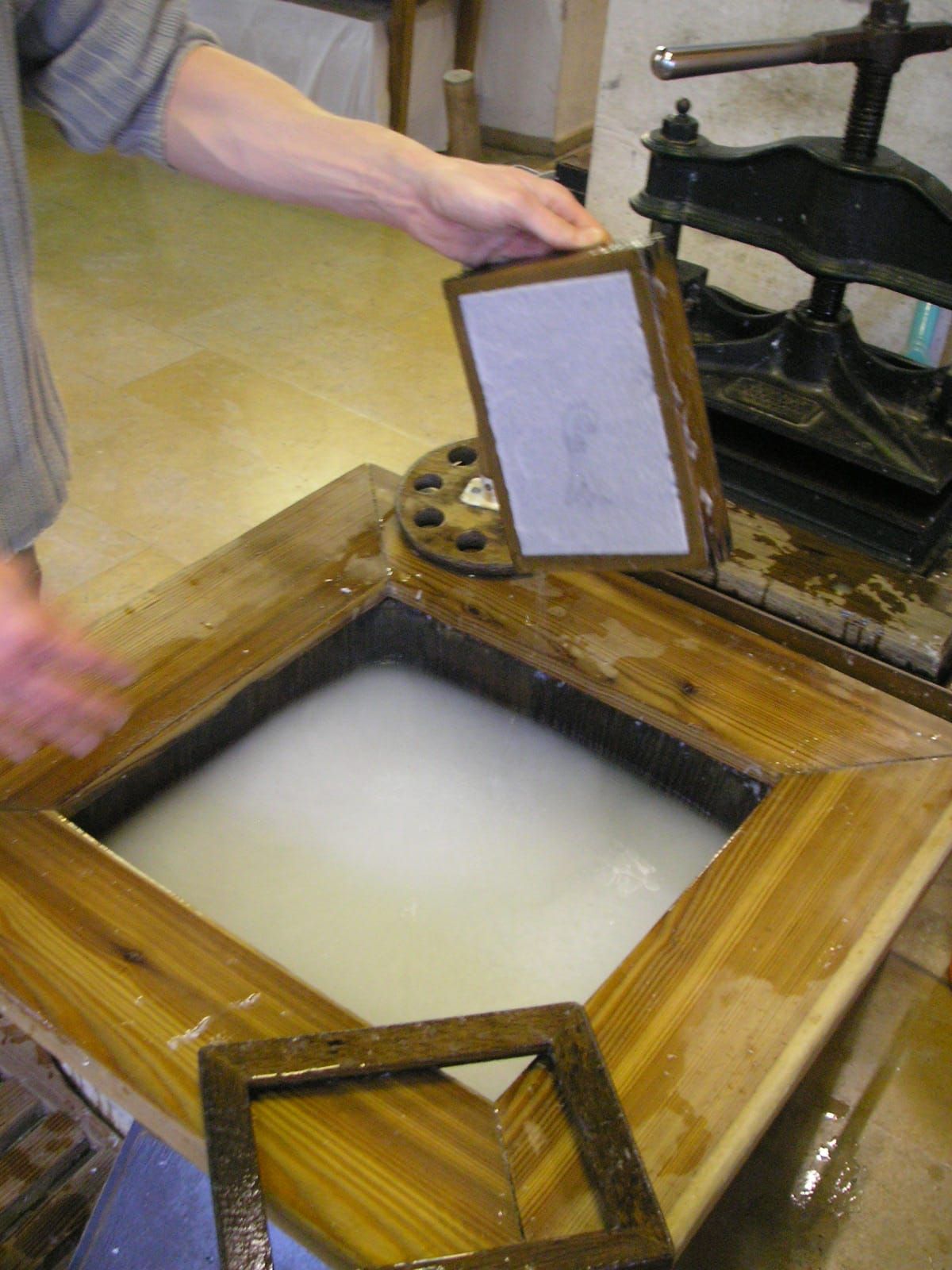
Wait until the stream of water slows to a drip, as Paperslurry describes. Lift the deckle straight up, keep it level at first, and move it to one side. Make: warns to lift it carefully so it does not pull the wet sheet with it. Keep it moving away from the sheet, not over it.
Keep your hands dry and out of the way
Hold the mould by its outer edges. Dry your hands before you reach over a formed sheet. A wet sleeve can drip just as well as a deckle.
Swing the mould away after couching
Ted Snider's couching method ends with one specific move: once the mould is clear of the felt, swing it to the right so that drops do not fall onto the wet sheet. Make that part of your routine.
Let the mould settle level
A fibre mat that is still fluid can slide or wrinkle if the mould is tilted too steeply, as Magnolia's glossary notes. Snider levels the mould immediately as it leaves the vat. Snider rests the mould on the vat's front edge and a sliding back board so that the drained water returns to the vat and the mould stays level.
Deal with bubbles
The Magnolia glossary lists froth or foam spots, also called bubble marks or bubble rings. Protein, gelatin, or other contaminants stabilize foam in the vat, and bubbles that survive into the sheet displace fibres. They leave circular, ringed, or crater-like marks. If foam lingers on your vat, look for one of those contaminants, and do not pull a sheet through standing foam.
Prevent it next batch
- Set a clear path for the deckle, away from the post and the fresh sheet.
- Keep a towel at the vat for your hands.
- Add the swing-away move to your couching routine.
- Look at the vat surface for foam before each pull.
- Note on your batch log whether a marked sheet was caught wet or dry.
When it's not fixable
A wet sheet with drip marks can go straight back in the vat. Take the deckle off, turn the mould over, and slap it flat onto the surface of the vat. Stir and pull again.
After couching and pressing, the mark stays. Accept it if it suits the piece, or re-pulp the sheet. The glossary notes that drops of water were hard to avoid in historical handmade paper too.
If marks appear in the same place on every sheet, check the screen.
FAQ
What do drip marks look like on a wet sheet?
Magnolia's glossary calls them crater-like. On a laid mould there is a clue to when the drop fell: the laid pattern stays visible inside a drip mark made before couching, and is disrupted or missing inside one made after couching.
Why are there craters after I lift the mould?
The usual reason is water falling from something above the sheet, such as the deckle, your fingers, or a wet sleeve. Make the lift a habit: drain, lift the deckle straight up, and move it away before anything drips. If there were no drips, look at air bubbles next.
Is a crater the same thing as a thin spot?
No. Magnolia's glossary describes drip marks as craters made when drops strike a sheet that has already formed. A thin spot is an area where less fibre settled during forming. Air trapped under a newly couched sheet is a third case: once pressed, the bubbles leave round thin areas with thickened margins.
Can water running off the deckle cause the marks?
Yes. Magnolia's glossary names the deckle as one source of the drops that make vatman's drip marks. Let the water drain to a drip before you lift the deckle, and move it away from the sheet rather than over it.
Related problems
Next stage: Why Is My Handmade Paper Sticking to the Mould?
Sources and further reading
- A Glossary of Flaws and Features Found in Handmade Paper, compiled by Donald Farnsworth and Max Thill (Magnolia Editions, version 7i)
- Couching, by Ted Snider (Hand Papermaking Newsletter #54)
- Sheet Formation and Uniformity, by Ted Snider (Hand Papermaking Newsletter #53)
- Here's How to Make Handmade Paper from Recycled Materials, by May Babcock (Paperslurry)
- Paper Making 101, by Francois Vigneault (Make:)